Tuesday, July 29, 2014

Toys to Tech: The Impact of Gender Stereotypes in the Tech Industry


I’d like to begin by drawing attention to the fact that I am an aspiring engineer. Only 18 years old and still a college education to go, I’m just now noticing the fact that there are very few female engineers. I’d never really noticed it before, or maybe I just didn’t care, but considering that I am entering the field, I realize “Where are all the females?” is a pretty good question to ask right about now. After living in the United States for my entire life, going through the American school system, and being part of an American generation, I believe I’ve discovered the answer to the question that Google is pouring incredible amounts of money and resources into. And quite unfortunately, with the conclusion that I’ve drawn, Google’s money can’t solve the problem this time. It is, without a doubt, the fault of our ancestors and the gender roles that have been assigned to us centuries ago. Although gender expectations have loosened tremendously over the ages, our actions of assigning gender roles to our children have transcended time, and sadly enough, they are far from intentionally sexist.
In researching and observing this topic in depth, I’ve found a number of articles that blame various different phenomena for the gender gap. In all of this, the articles and posts that have sat worst with me were those condemning women for not taking it upon themselves to enter the industry. One article entitled “Women and Video Gaming’s Dirty Little Secret” ridicules women for allowing the fear of sexism to dissuade them from entering the tech fields. Although I agree that sexism within the workplace is not something that should be feared, when author and head of her company’s Human Resources department, Gabrielle Toledano says, “If women don’t join this industry because they believe sexism will limit them, they’re missing out,” she misses the point completely. Nowhere in the article does Toledano provide a real reason why women are not joining into the industry, she only states that women are needed and should not be scared to join. But contrary to what Toledano writes, women actually aren’t scared to join, they’re simply taught not to.
To test my own theory about this, I conducted a small survey on my college campus. I asked both males and females what their majors were, and what prompted them to choose their respective majors. Not surprisingly, approximately 80% of the students I surveyed claimed that they had a life experience that made them realize that they wanted to pursue their field of interest. Many cited childhood experiences including but not limited to toys, trips, and clubs. One man shared a story about how a father and son camping trip sparked his interest in plant biology. A father and son trip is such a rite of passage that many deem part of “our culture.” But where did this culture originate from? Father and son outings have been around for many generations, generations that our ancestors were part of. It is not intentionally sexist to have a father and son camping trip nor a mother and daughter spa day, but these events expose us to certain experiences, and shape us in certain ways. They promote gender stereotypes that we do not think of as a problem.
Although the father and son camping trip example does not directly have to do with engineering (considering the boy was not even an engineering major), it does show that gender roles expose us to certain events that the other gender does not get to experience as easily. Gender specific outings promote stereotypes that do not trouble us; stereotypes that are so embedded within our culture that we do not even think of them as stereotypes anymore. We simply accept that that is how our world works, but it just so happens that these events shape our futures more than we think about. In this specific example, without truly realizing it, we encourage boys to be adventurous and to build things, and we influence girls to be beautiful.
On a blog called Lea’s Pensieve, Lea makes many incredibly good points about how daily life shapes people and allows them to cultivate their interests. She includes this comic as an example of how gender roles set boys up to become engineers and women up to become caretakers. In this example of presents given to boys versus those given to girls, it is hard to argue that the parents are trying to actively encourage the boy to become an engineer but not for the girl to be. Most of the time, little things such as childhood toys are able to make a large impact on the interests of the child. Interests are often cultivated at a young age, and if girls are not encouraged to be creative and mechanically imaginative in their youth, the chances that they will grow up to be an engineer will lessen significantly.
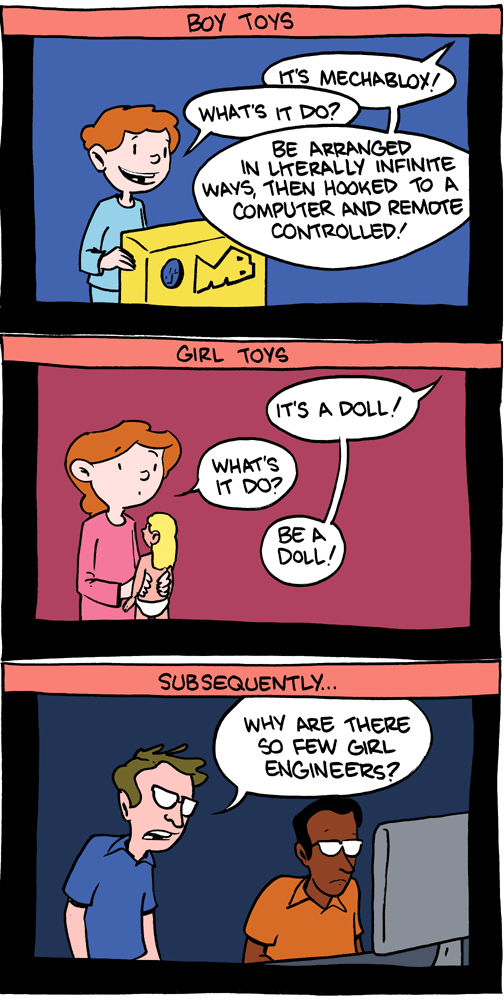
20100516.gif
I really do not believe that sexism in the workplace keeps women out of the tech industry. How could it? How could they choose not to study in the STEM fields because of sexism that they have not even experienced? They have not yet stepped into the workplace before they choose not to enter it. No, something is stopping women from even attempting to pursue the subjects. Our gender expectations are inherently sexist, and they are expectations that need to change. We need to start giving our kids equal opportunities to become interested in any given subject, and not let our ancestors and traditional gender roles define our futures.
Perhaps it was because my father never had any sons, or perhaps we can attribute it to his incredibly forward thinking, but while some families had season passes to theme parks, mine had a membership at the Tech Museum. Every weekend, we would go listen to lectures on biotechnology and how entire diseases were being eradicated in different parts of the world because of the incredible technology that people had been devising. My childhood experiences directly impacted my interests and thus led me to my major today. All that mattered was that I became interested in what I was being exposed to, and that is something that women are lacking in this day and age.
Why is it that nobody can pinpoint this flaw in our upbringing? I’ve seen complaints about sexism within the workplace, entire books on how the American school system favors boys, and articles about how math and science are not given importance (care to explain the male engineers then?). But the solution to having more women in tech lies in something so much more simple. It lies in encouragement of young girls to pursue engineering by being creative and not letting traditional gender roles inhibit the changing world and workforce. It starts with our parents. It did for me, anyways.

It Begins at High School


A Unique Look at the Reasons Why Women aren’t Represented in the Tech Industry

Daniel Park


T
he lack of women in the sciences goes beyond the seemingly obvious problem of misogyny and even past our claimed biological differences. Being a male student interested in math & science in the Silicon Valley, I had a unique insight into the root of the problem where major technological advances began. Over the past 4 years, I have come to believe that the gender imbalance is a structural issue that begins in the male-dominated classrooms that discourages female participation.

In high school, I had a friend named Julia Huang – we had computer science class together in our sophomore year – and she’s a good example against women being uninterested in the sciences. Having an incredible work ethic, she studied more than anyone else to be internationally ranked in various math, science, and computer science competitions. And all her hard work manifested itself in the form of a college acceptance when she skipped her senior year of high school to begin studying at MIT as a freshman.


Even with Julia as a counter-example of the popular stereotype, it’s undeniable that there’s a bias towards men in the technology industry. There exist numerous explanations for this occurrence and I contend that it goes past the simple explanation of sexist hiring practices (Source 1). Although this has a kernel of truth, there are far more important factors at work that explain the striking gender inequality.

Foremost, the problem begins with the parents of confused, college-headed high school graduates, especially in the bay area. Parents (mostly Asian) would tell their sons: “You are going to study computer science in college and work your way up at a big company like Apple or Google.” And to their daughters: “You are going to study pre-med in college and become a doctor.” It’s shocking how prevalent this type of thinking has come to be in the Silicon Valley. My parents are no exception and it is no surprise that my sister is planning on being a doctor later in her life. I made a conscious choice to reject their plea and opted to study business/ economics because I wanted to work on Wall Street. As for the less-revolting, more complacent students my age, they listen to their parents and work tirelessly to land a job at a prestigious institution. Although hard to grasp at first, this influence from parents shouldn’t be ignored because it carries a lot of weight to the children, especially since computer science has tradition-ally been a male occupation.


Aside from parents, the biggest factor that affects the imbalance is group dynamic among students active in the sciences. Having been among such students, I can attest that girls are generally left out in group projects because when there are 9 guys and 1 girl in a class, the girl feels as though she doesn’t belong there. An environment that crowds out female involvement only perpetuates the problem because the younger generation would look to those before them and decide to pursue a different track. Many women justify this by arguing that because men dominate the top 100 places across all science competitions, it must be harder for girls to reach the top (Source 2). This could not be further from the truth because when the playing field is skewed to have a male population that’s 10 times bigger than the female’s, it’s statistically bound to have less female top-performers. It becomes a self-fulfilling prophecy for the engineer girls and feeds into the larger problem of being paid less in the industry and also being underrepresented.


In the real world, there have been some attempts by successful women to reverse the downward trend of female participation, most notably by Sheryl Sandberg, COO of Facebook. She writes that the whole problem is bigger than just in engineering, because, “we know that by middle school, more boys than girls want to lead” (Source 3). Former Secretary of State Condoleezza Rice and Girl Scouts CEO Anna Maria Chavez joined Sandberg in her efforts to empower young women. “This is a word that is symbolic of systemic discouragement of girls to lead… We’re talking about getting rid of the negative messages that hold our daughters back,” Sandberg said (Source 3). Powerful women in the industry are working with others to change the gender imbalance in the workforce. “If you look at the world, women do 66 percent of the work in the world … We are 5 percent of the Fortune 500 CEOs … We are 19 percent in Congress,” Sandberg explained (Source 3). It is clear that the problem is not one to be ignored but to be carefully considered by the most influential people in the world.


At the end of the day, the problem doesn’t lie with all males being sexist against women but rather the environment in which students are situated. Yes, some men in management roles are misogynistic and hire based on their biases. No, that’s not the only reason why there’s such a huge discrepancy in the number of men and women in the sciences. We need to fundamentally change the way girls participate in math/science competitions and encourage a symbiotic relationship between the two genders. Until we do so, women will never be at their desired positions in the technology industry.


Female Revolution... The Next Step Up


Male and female, what is the big deal? At the end of the day we all need the same things to survive, oxygen and water. According to the Merriam-Webster dictionary online: a male is an individual that produces small usually motile gametes which fertilize the eggs of a female, and a female is relating to or being the sex that bears the young or produces eggs. Notice no were in either one of those definitions does it say that women are less intelligent or inferior to men in any way; so why the discrepancies and sexism when it comes to distinguishing what one can and can’t do in terms of profession?
Over decades it seems as if men have been given more opportunity to excel in the tech industry as compared to girls. So now as times move on and times change so do the social environments, women are overcoming these stereotypes that only men can lead in the tech industry. But, there are still many females out there who do not know how to overcome the back lash and negativity that society bestows upon them for entering a male dominated profession. During my research I came across and article on the Australian Institute of Criminology website about Women in a Male Dominated Industry, stating women are often perceived as invaders or visitors in male dominated professions. I strongly agree with this statement, because only 45% of our women in the tech industry hold leadership positions in the tech industry.
The Forbes magazine did an interesting article on Women in the Technology Industry and Leadership positions by Naomi Shavin, and to their surprise like many other such as I myself, the results were pretty astounding. With the 21st century, and women excelling not only in the educational fields but in all aspects of the science and technology industries, the US holds a national average of 45% females hold some sort of leadership position in the technology world, while Europe averages a 50% and Asia averaging a 56%. As Naomi Shavin goes on in the article she finds in her research, that the Silicon Valley Bank while conducting a study on what woman had to overcome to take the position they do, the woman who wrote the article Devin stated that on a recent dinner with colleagues and clients she noticed “’ “It was 24 men,” said Devin, “and me.” ’”. In today’s world when it comes to woman leading you often she they are surrounded by a group of men, they tend to be told what to say and what to do or how to act. They normally all have “male assistant” that refers them from time to time of, say this or do this. While being one of the largest countries not just military wise but economy wise, why are we so behind when it comes to equal rights for both women and men? Although there are many programs out there these days encouraging girls to enter the tech field, we need to ask ourselves is that enough? Many of the problems that start happen after woman have received their degrees and jobs, woman are “ viewed as visitors who will either leave because they are given no opportunity to move up in position or because they are paid less for being an equally efficient engineer or technician that a male is and in many cases a better one. Many programs these days are trying to resolve issues of gender inequality and discrimination in workplaces by encouraging women to pursue STEM professions, like the POWER (People Organized to Win Employment Rights) helps fight for woman equality in STEM professions and also the Everyday Sexism which promotes women to post stories and experiences they have held in tech fields to encourage young females.
Stepping aside from community and national level resolutions, we can start in our own backyard. I work at Lowe’s Home Improvement, everyone living in the bay area is familiar with the type of retail store this is, heck it tells you in the name; Home Improvement. I have been working here for about nearly a year and half, and within that year I have seen many employees come and go. Our store consists of say about 200 plus if minus a few.  And out of all these employees we have 3 women out on the sales floor working in the departments, 2 woman that are department managers one for plumbing, one for customer service, and lastly we have about 13 women who are all cashiers and 7 of us are customer service reps. Now if you total these numbers up we have about say 30 plus or minus a few women working in a home improvement store, however only 2 of those women hold a leadership position. Interesting, how out of about 1/8 of their employees being women only two hold a leadership position.
Although everyone says we have changed and become more accepting of women in tech professions, women themselves and the stats say otherwise. My point isn’t to point fingers and scare people away, just to point out that there is an aggressive issue beyond us and that we need to do something about it soon before a becomes a male-monopoly and it’s too late.


  •  http://www.forbes.com/sites/naomishavin/2014/07/21/the-latest-statistics-on-women-in-technology-leadership/
  • http://www.theguardian.com/lifeandstyle/womens-blog/2013/oct/17/women-in-science-ada-lovelace-gender
  • http://www.svb.com/women-in-technology/